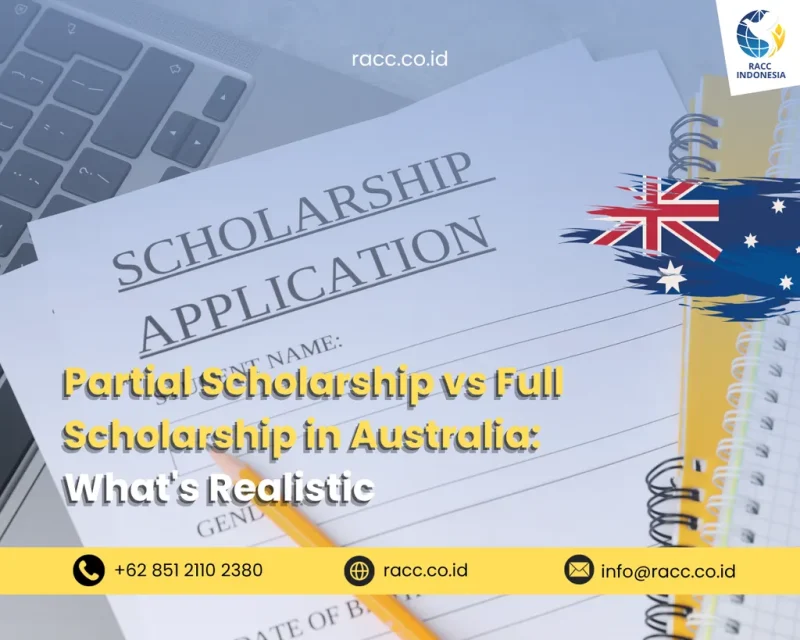
Partial Scholarship vs Full Scholarship in Australia: What’s Realistic
If you are weighing a partial scholarship vs a full scholarship in Australia, the honest answer is that most students receive partial funding, not full funding. A full scholarship covers tuition plus living costs and is rare outside government and research programs. A partial scholarship trims your tuition and leaves the rest to you. This guide breaks down what each type actually covers, the real cost you still pay after a partial award, and which target is realistic for an Indonesian student in 2026. Last updated: July 2026 Partial vs Full Scholarship: The Quick Answer A full scholarship pays for all or nearly all of your study, while a partial scholarship reduces one part of the bill, almost always tuition. That single difference decides how much you still need to fund yourself. Here is the side-by-side view for study in Australia: Feature Full Scholarship Partial Scholarship Tuition Fully covered 10 to 75 percent covered Living allowance Usually included Rarely included Airfare and health cover Often included Not included Who offers it Government (Australia Awards), research programs (RTP), and a few elite awards Most universities, as merit or country awards Availability Scarce, mostly postgraduate Common, all study levels How you apply Separate competitive application Often automatic with your offer The takeaway: full scholarships are the exception, not the plan. Partial scholarships are what most students actually win, so the smart question is not “how do I get everything paid for?” but “how small can I make the gap I still have to cover?” What a Full Scholarship Actually Covers A full scholarship in Australia does more than waive tuition. It typically funds your living costs, flights, and insurance too, which is why these awards are limited and highly competitive. For Indonesian students, three realistic full-funding routes exist. Australia Awards and Garuda Scholarships The Australia Awards Scholarships are the main fully funded pathway for Indonesians. They cover full tuition, return airfare, a Contribution to Living Expenses, Overseas Student Health Cover, and pre-departure English training, according to Australia Awards Indonesia. Applications for the 2026 intake opened on 1 February 2026 and closed on 30 April 2026, per the Australian Embassy Jakarta scholarships page. RACC covers this route in depth in its Australia Awards Scholarship Indonesia guide. The newer Australia Awards Garuda Scholarships fund Master’s study in education for Indonesian educators linked to the Garuda Schools Program, with the same full-support package, as announced by the Australian Embassy in 2026. Both target postgraduate study, not undergraduate. Research Training Program (RTP) If you are heading into a research master’s or PhD, the Research Training Program funds tuition and often a living stipend at Australian universities, financed by the Australian Government. Coverage and stipend rates vary by university, so confirm the amount with each institution’s graduate research office. Elite university merit awards A small number of universities offer near-full merit scholarships, but these go to a handful of exceptional applicants each year. Treating one as your funding plan is risky. Chasing rare 100 percent awards while ignoring achievable partial ones is the most common mistake we see. The realistic full-funding routes for Indonesians are Australia Awards and research funding, not undergraduate merit prizes. What a Partial Scholarship Covers, and What You Still Pay A partial scholarship reduces your tuition by a set percentage or fixed amount, and that is usually where the help stops. Living costs, health cover, and the remaining tuition stay on you. This is the section most scholarship guides skip, so here are real 2026 numbers. International undergraduate and postgraduate tuition sits at between AUD 20,000 and 50,000 per year. A single student in Sydney or Melbourne spends around AUD 29,710 to 35,000 a year on living costs, the same figure the Department of Home Affairs uses as the visa savings benchmark. Here is what a partial tuition scholarship leaves you paying on a AUD 40,000 tuition bill: Scholarship size Tuition you still pay Plus living costs Rough annual gap 25 percent off AUD 30,000 AUD 30,000 AUD 60,000 50 percent off AUD 20,000 AUD 30,000 AUD 50,000 75 percent off AUD 10,000 AUD 30,000 AUD 40,000 Notice the gap barely moves once living costs enter the picture. A generous 50 percent tuition waiver still leaves roughly AUD 50,000 a year to fund. That is not a reason to skip partial scholarships. It is a reason to plan honestly and know your real number before you accept an offer. Book a consultation with RACC Indonesia if you want help mapping your funding gap before you commit to a course. You can also browse RACC’s scholarships in Australia for Indonesians guide to see which programs fit your level. What’s Realistic for an Indonesian Student Here is the practical decision framework. If you are applying for a research master’s or PhD, aim for full funding through Australia Awards or the RTP, because those programs exist for exactly your situation. If you are applying for an undergraduate or coursework master’s degree, plan around a partial scholarship and a funding gap you cover through savings, family support, and legal part-time work. Two facts change the math in your favour. First, student visa holders on a Subclass 500 visa can work while studying, currently capped at 48 hours per fortnight during term, which offsets living costs. Second, most graduates qualify for a Temporary Graduate visa (Subclass 485), giving two to four years of post-study work rights, so your degree keeps earning after you finish. Put together, a partial scholarship of AUD 10,000 to 15,000 a year plus part-time work plus post-study earnings can make an Australian degree pay off, even with no full scholarship in sight. A full award is a bonus, not a prerequisite for a strong return. The students who struggle are usually the ones who assumed a 100 percent scholarship would appear and made no backup plan when it did not. How to Improve Your Odds Whether you are targeting partial or full funding, a few moves genuinely lift your chances: One timing trap