Why Australia Needs Air Conditioning & Refrigeration Mechanics
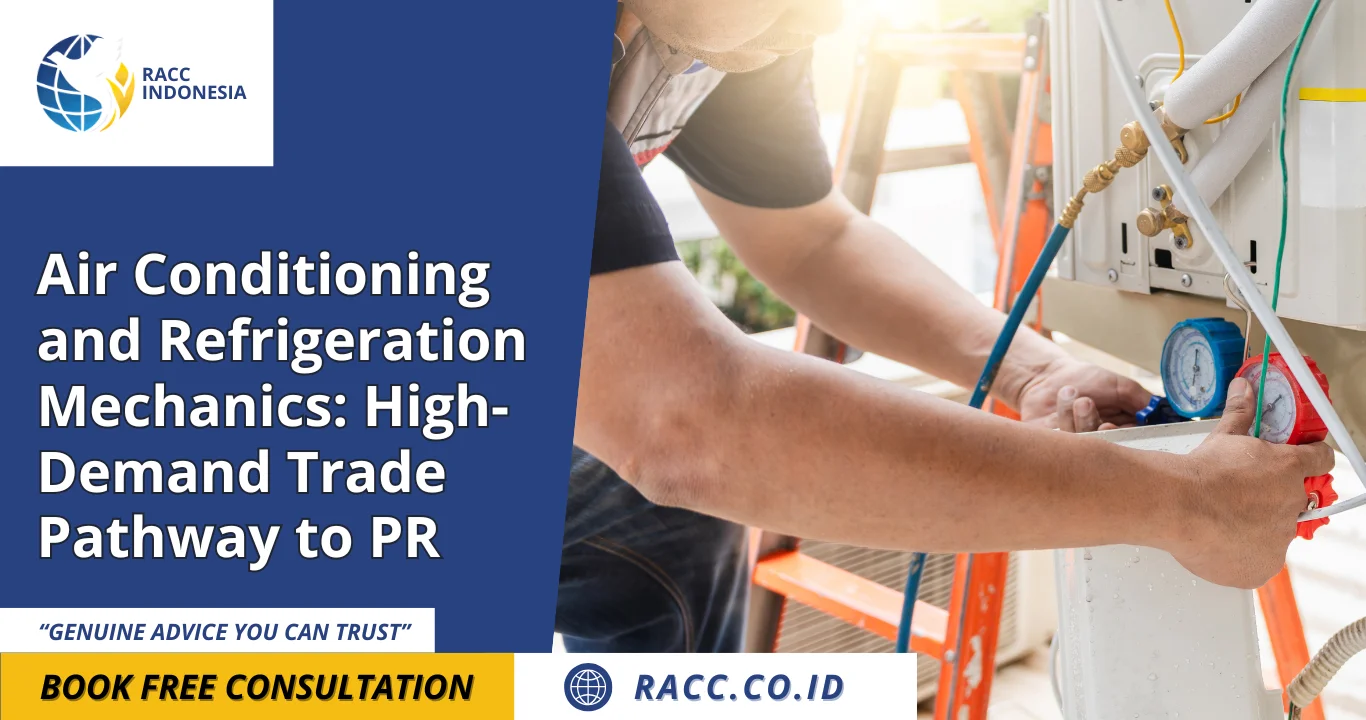
Australia is facing a nationwide shortage of Air Conditioning and Refrigeration Mechanics (ANZSCO 342111), a vital trade supporting everything from household cooling systems to large-scale industrial refrigeration. As construction expands, temperatures rise, and industries rely heavily on climate-controlled environments, demand for skilled HVAC-R technicians continues to increase across every state and territory.
This occupation is essential for maintaining:
- Residential and commercial air conditioning systems
- Refrigerated storage for supermarkets, restaurants, and logistics centres
- Industrial cooling systems for manufacturing and mining operations
- Energy-efficient HVAC systems in hospitals, airports, and public buildings
Because this trade is critical to Australia’s infrastructure and food safety supply chain, it is officially listed on the Medium and Long-Term Strategic Skills List (MLTSSL).
This means the occupation is eligible for Subclass 189 Skilled Independent PR, making it one of the strongest PR pathways among all trade occupations.
Air Conditioning and Refrigeration Mechanics benefit from:
- Eligibility for Subclass 189 (PR without sponsorship)
- Strong chances for Subclass 190 and 491 state nomination
- High demand in both metro and regional areas
- Attractive salaries and long-term job security
- Employer-sponsored visa opportunities (482, 186, 494)
Regional Australia faces even more severe shortages, especially in mining, cold-chain logistics, and industrial cooling operations, creating faster and more accessible PR pathways.
For overseas tradespeople and international students finishing a Certificate III in Air Conditioning and Refrigeration, this occupation offers a reliable route toward full-time work, strong income potential, and long-term residency in Australia.
Understanding the Occupation (ANZSCO 342111)
Air Conditioning and Refrigeration Mechanics, often referred to as HVAC-R Technicians, install, maintain, and repair cooling and refrigeration systems across residential, commercial, and industrial settings. This occupation requires both technical skill and strong compliance with Australia’s strict safety and environmental regulations, particularly around refrigerant handling.
Because of their specialised expertise, HVAC-R mechanics are essential to multiple sectors, including construction, food logistics, facility management, manufacturing, and mining. Their role is diverse, hands-on, and consistently in demand across all states and territories.
Key Responsibilities
Common duties performed by Air Conditioning and Refrigeration Mechanics include:
- Installing split systems, ducted air conditioning, and VRF systems
- Diagnosing electrical, mechanical, and refrigerant-related faults
- Repairing and maintaining refrigeration units, cool rooms, and freezers
- Servicing commercial HVAC systems in offices, hospitals, malls, and hotels
- Installing ventilation and air filtration systems
- Testing system performance and ensuring compliance with Australian Standards
- Safely handling and charging refrigerants (ARCtick requirement)
- Performing routine maintenance and preventative service work
- Reading and interpreting mechanical drawings and wiring diagrams
These responsibilities require strong technical competence, problem-solving skills, and a solid understanding of electrical and refrigeration systems.
Work Environments
HVAC-R technicians are employed in a wide range of industries, including:
- Residential installation and service companies
- Commercial building maintenance (offices, hospitals, data centres)
- Industrial cooling and ventilation operations
- Cold storage, supermarkets, and food processing facilities
- Mining and resource sector sites (high salary demand)
- HVAC-R contracting and project firms
- Facility management and engineering services providers
The diversity of work environments allows technicians to specialise in domestic, commercial, or industrial systems depending on their career goals.
Required Skills & Tools
Successful Air Conditioning and Refrigeration Mechanics must possess:
- Strong electrical and mechanical fault-finding skills
- Knowledge of refrigeration cycles and HVAC systems
- Ability to use gauges, multimeters, leak detectors, and diagnostic tools
- Understanding of refrigerant types and handling procedures
- Compliance knowledge (safety codes, ventilation standards, ARCtick rules)
- Physical fitness for working at heights, in tight spaces, and in hot environments
- Customer communication and problem-solving skills
Technicians working in industrial or mining roles may need advanced skills in ammonia refrigeration systems and large-scale industrial chillers.
Licensing Requirements in Australia
In addition to skills assessment, HVAC-R technicians must obtain the required licences to work legally:
- ARCtick Refrigerant Handling Licence (mandatory nationwide)
- Restricted or full Electrical Licence (varies by state, depending on the work)
- Construction White Card (required for worksites)
Licensing ensures workers maintain Australia’s strict standards for safety and environmental protection.
Skills Assessment Requirements (TRA – Trades Recognition Australia)
A positive Skills Assessment from Trades Recognition Australia (TRA) is mandatory for Air Conditioning and Refrigeration Mechanics who wish to apply for skilled migration or employer-sponsored visas. TRA ensures that your skills match the Australian standard for Certificate III in Air Conditioning and Refrigeration and that you are competent in both technical and safety-related aspects of the trade.
The assessment pathway depends on whether you trained overseas or completed your qualification in Australia.
Assessing Authority: Trades Recognition Australia (TRA)
TRA is responsible for evaluating both qualifications and practical experience for all licensed trades.
For ANZSCO 342111, TRA assesses:
- Technical skill
- Refrigeration knowledge
- Electrical understanding
- Safety compliance
- Practical hands-on ability
Two main pathways exist: OSAP for overseas-trained workers and JRP for international students in Australia.
OSAP (Offshore Skills Assessment Program) – For Overseas-Trained Workers
This pathway applies to applicants who completed their trade qualification outside Australia.
Requirements include:
- A qualification equivalent to Cert III in Air Conditioning and Refrigeration
- At least 3–5 years of relevant work experience
- Work performed must align with ANZSCO 342111 duties
- Evidence of recent employment (minimum 12 months in the last 3 years)
OSAP Assessment Steps:
- Document Assessment
- Qualifications
- Employment references
- Photos/videos of work
- Payslips and contracts
- Technical Interview or Practical Assessment
- Demonstration of refrigeration and HVAC skills
- Safety and compliance knowledge
- Electrical fault-finding
- Refrigerant handling techniques
A positive OSAP result is required for PR and employer-sponsored visas.
Job Ready Program (JRP) – For International Students in Australia
International students who complete a Certificate III in Air Conditioning and Refrigeration can follow the JRP pathway.
Requirements include:
- A completed Australian trade qualification
- A valid Subclass 485 Post-Study Work Visa
- At least 1,725 hours of paid employment in the HVAC-R industry
- Workplace assessment by TRA
JRP Steps:
- Provisional Skills Assessment (PSA)
- Job Ready Employment (JRE)
- Job Ready Workplace Assessment (JRWA)
- Job Ready Final Assessment (JRFA)
After completing JRP, applicants receive a full skills assessment for migration.
Licensing Requirements (ARCtick & Electrical)
In addition to TRA, HVAC-R technicians must hold:
- ARCtick Refrigerant Handling Licence (mandatory nationwide)
- State-based Electrical Licence (full or restricted, depending on duties)
- White Card (for construction sites)
TRA skills assessment alone does not grant the licences—it confirms trade competency required before applying for them.
English Language Requirements
For skilled migration, applicants must meet the minimum English standards:
- IELTS 6.0 (each band), or
- PTE Academic equivalent
Higher scores improve PR points for Subclass 189 and 190.
Why TRA Assessment Matters
A positive TRA result allows candidates to:
- Apply for Subclass 189 (Skilled Independent PR)
- Apply for Subclass 190 or 491 (state nomination)
- Qualify for 482, 494, and 186 employer-sponsored visas
- Demonstrate trade competency to Australian employers
TRA is the foundation of your migration journey as an HVAC-R technician.
PR Pathways for Air Conditioning & Refrigeration Mechanics
Because Air Conditioning and Refrigeration Mechanic (ANZSCO 342111) is listed on the Medium and Long-Term Strategic Skills List (MLTSSL), it has some of the strongest and most flexible PR pathways of any trade occupation. Skilled workers in this trade can choose between independent migration, state nomination, and multiple employer-sponsored options.
Below is a clear overview of all available pathways.
Subclass 189 – Skilled Independent Visa (PR)
No sponsor, no state nomination — direct PR.
Since the occupation is on the MLTSSL, eligible candidates may apply for Subclass 189 after obtaining a positive TRA skills assessment and meeting the required PR points.
Benefits:
- Permanent Residency from day one
- No job offer required
- No obligation to live in a specific state
- Ideal for applicants with strong English and high points
This is one of the most attractive pathways for HVAC-R technicians globally.
Subclass 190 – Skilled Nominated Visa (PR)
PR with state nomination + 5 PR points.
Many states frequently list Air Conditioning & Refrigeration Mechanics due to chronic trade shortages. Applicants who meet state requirements can receive an invitation faster through 190.
Why 190 is strong:
- Direct Permanent Residency
- Extra 5 points from the nominating state
- Popular in NSW, VIC, QLD, SA, WA, and TAS
State nomination can significantly reduce waiting time for an invitation.
Subclass 491 – Skilled Work Regional (Provisional → PR)
5-year visa with PR via Subclass 191.
This is often the easiest and fastest pathway because construction trades are in extremely high demand in regional areas.
Advantages:
- +15 PR points from regional nomination
- High availability in SA, TAS, regional NSW & QLD, WA regional
- Leads to PR after 3 years (Subclass 191)
- Improved job opportunities in regional towns
Many HVAC-R technicians choose the 491 pathway due to higher invitation chances.
Employer-Sponsored Pathways (Ideal for those already working in Australia)
Employer sponsorship is common in commercial cooling, supermarkets, facility management, and industrial refrigeration. Companies in mining regions and regional towns often urgently sponsor skilled technicians.
a. Subclass 482 – Skills In Demand Visa
- Full-time work with an approved employer
- Pathway to PR under Subclass 186
- Often used for industrial or commercial HVAC roles
b. Subclass 186 – Employer Nomination Scheme (PR)
- Direct PR (if eligible), or
- PR transition after holding a 482 visa
- Suitable for experienced technicians with strong employer support
c. Subclass 494 – Regional Employer Sponsored (Provisional → PR)
- 5-year visa for regional employers needing skilled technicians
- PR transition through Subclass 191
- Widely used in regional QLD, WA mining, NT, and rural towns
Why This Occupation Has Strong PR Potential
- Listed on the MLTSSL (eligible for 189)
- Consistent demand across all states
- Essential trade for construction, cold-chain logistics, and energy efficiency
- High sponsorship activity from employers
- Severe shortages in regional Australia
- Pathways available for both overseas and onshore applicants
The combination of multiple PR pathways makes HVAC-R one of the most reliable trades for long-term migration to Australia.
Job Market & Industry Outlook in Australia
Air Conditioning and Refrigeration Mechanics are among the most consistently in-demand trades in Australia. As the country expands its residential housing, commercial buildings, industrial operations, and cold-chain logistics, HVAC-R professionals remain essential to maintaining safe and energy-efficient environments. This demand is year-round and spans every state and territory.
Industries Hiring HVAC-R Technicians
Air Conditioning and Refrigeration Mechanics work across a wide variety of sectors, including:
Residential & Commercial Construction
- Installation of split systems, ducted systems, VRF units
- New builds, renovations, and project-based installations
Commercial Facility Management
- Office towers, hospitals, airports, shopping centres
- Maintenance of large-scale HVAC systems
Cold Storage, Food & Beverage Industry
- Supermarkets, refrigerated warehouses, food processing plants
- Ensuring temperature-sensitive goods remain safe
Industrial & Manufacturing
- Factory cooling systems
- Industrial chillers and process refrigeration
Mining & FIFO Operations
- High-salary positions in WA, NT, and QLD mining regions
- Climate control for mine sites, camps, workshops
Service & Maintenance Companies
- Continuous work orders for repairs and system servicing
- Strong opportunities for apprentices and newly qualified technicians
State Demand Overview
New South Wales (NSW)
- High demand across Sydney and regional NSW due to population growth and commercial construction.
Victoria (VIC)
- Large commercial sector requiring ongoing maintenance and installation.
Queensland (QLD)
- Year-round heat drives strong residential and commercial HVAC demand.
Western Australia (WA)
- Extremely high demand in mining and industrial sectors, with many employers willing to sponsor.
South Australia (SA)
- HVAC shortages in both metro and regional towns; strong 491 interest.
Tasmania (TAS)
- Smaller market but consistent shortage of qualified technicians.
Northern Territory (NT)
- High demand due to climate and remote industrial operations.
Salary Expectations
Salaries vary based on location, experience, and specialisation:
- Entry-Level Technician: AUD 60,000–70,000
- Qualified HVAC-R Technician: AUD 75,000–95,000
- Commercial / Industrial Technician: AUD 90,000–120,000
- Mining / FIFO Roles: AUD 120,000–150,000+
Overtime, call-out work, weekend shifts, and remote loading can substantially increase earnings.
Why Regional Australia Offers Faster PR
Regional areas experience the most acute trade shortages, leading to:
- Higher demand for technicians year-round
- More employer sponsorship opportunities (482, 494)
- Stronger chances for Subclass 491 nomination
- Faster PR pathways due to regional incentives
Mining towns, agricultural processing hubs, and remote communities rely heavily on skilled HVAC-R technicians and often struggle to recruit locally.
Opportunities for International Students (485 Pathway)
International students who complete a Certificate III in Air Conditioning and Refrigeration can apply for the Subclass 485 Post-Study Work Visa, allowing them to:
- Gain paid work experience
- Complete the Job Ready Program (JRP)
- Obtain full TRA skills assessment
- Strengthen their eligibility for 189, 190, or 491
This is one of the most straightforward trade PR pathways for students in Australia.
How RACC Indonesia Can Help Skilled Trade Workers
Migrating to Australia as an Air Conditioning and Refrigeration Mechanic involves several technical steps, TRA skills assessment, state nomination, employer sponsorship, and visa preparation. RACC Indonesia supports applicants through every stage to ensure your pathway to Permanent Residency is smooth, accurate, and optimised for the best outcome.
TRA Skills Assessment Support (OSAP & JRP)
RACC assists applicants in preparing strong submissions for both offshore and onshore pathways:
For Overseas Workers (OSAP):
- Reviewing qualifications and verifying Cert III equivalency
- Drafting and formatting employment reference letters
- Organising evidence: photos, videos, payslips, contracts
For International Students (JRP):
- PSA submission after completing Cert III
- Guidance for Job Ready Employment (JRE) requirements
- Final Skills Assessment lodgement
A complete and accurate TRA application significantly increases PR success.
PR Points Calculation & Migration Strategy
RACC provides a personalised migration plan by reviewing:
- Age, qualifications, and work experience
- English test scores
- TRA outcome
- Eligibility for Subclass 189 (MLTSSL occupation)
- State nomination prospects for 190 or 491
This ensures you choose the strongest and fastest pathway available.
State Nomination Assistance (Subclass 190 & 491)
Since HVAC-R Mechanics are frequently listed on state occupation lists, RACC helps by:
- Lodging Expressions of Interest (EOI)
- Preparing Registrations of Interest (ROI) for each state
- Identifying states with the highest invitation rates
- Ensuring full compliance with each state’s criteria
This maximises your chance of receiving a nomination for PR or provisional residency.
Employer-Sponsored Visa Support (482, 186, 494)
Commercial refrigeration companies, supermarkets, mining operations, and regional employers often sponsor skilled HVAC-R technicians.
RACC assists with:
- Employer eligibility checks
- Sponsorship and nomination lodgement
- Visa application preparation
- PR transition through Subclass 186 or 191
Employer sponsorship is extremely valuable for applicants with strong work experience but limited PR points.
Support for International Students (485 Pathway)
For students completing HVAC-R courses in Australia, RACC helps with:
- Subclass 485 Post-Study Work Visa lodgement
- Planning PR pathways after obtaining full skills assessment
This pathway leads directly toward Subclass 189, 190, or 491 eligibility.
Complete Visa Lodgement & Free Consultation
RACC Indonesia handles full preparation and lodgement for:
- TRA assessments
- Skilled visas (189, 190, 491)
- Employer-sponsored visas (482, 186, 494)
- 485 Post-Study Work Visas
We offer free consultations to help skilled tradespeople confidently plan their future in Australia’s high-demand HVAC-R industry.