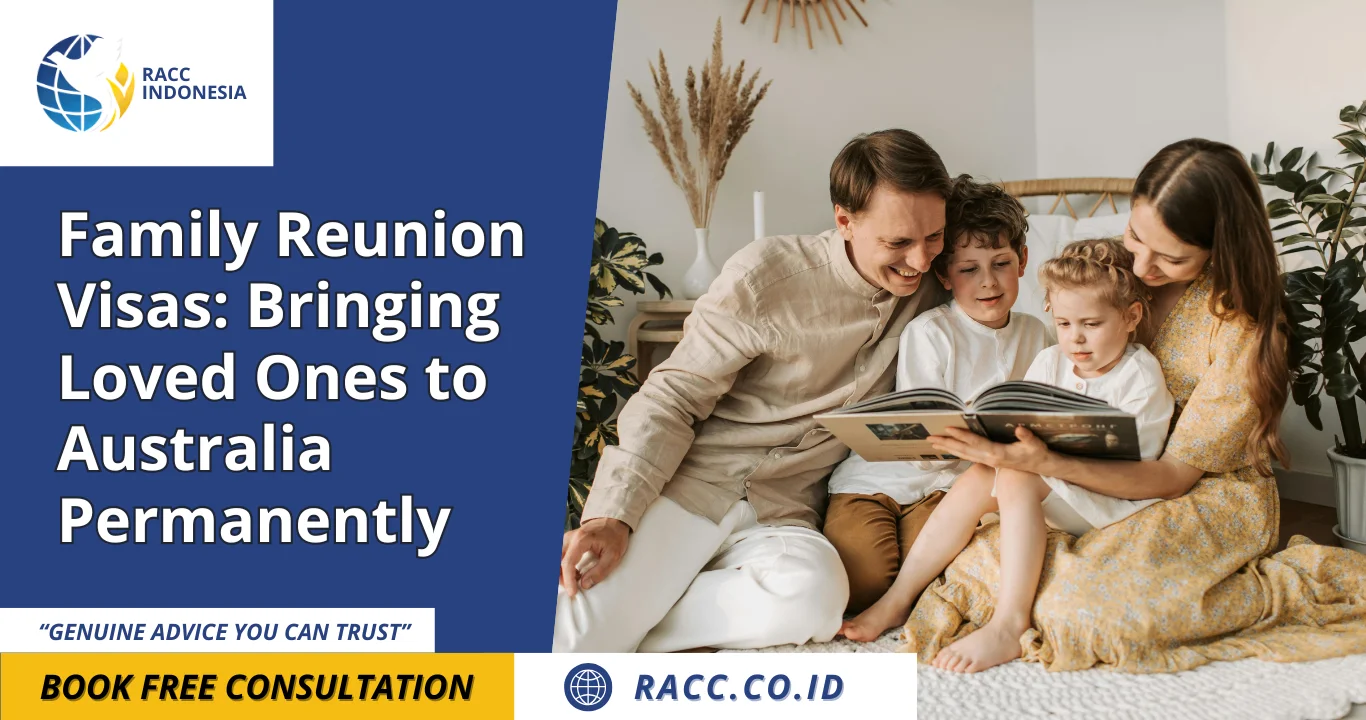
Family Reunification in Australia
Australia places a strong emphasis on family migration, recognising the importance of keeping families together. Through the Family Reunion Visa program, Australian citizens and permanent residents can sponsor their spouses, children, parents, and other close relatives to live in Australia permanently.
This program is designed to support migrants who have already built a life in Australia and wish to bring their loved ones to join them, whether that means reuniting with a partner, caring for elderly parents, or providing stability for dependent children.
There are several visa categories under Australia’s Family Migration Stream, each tailored to different family situations. Some focus on immediate family members (such as partners and children), while others extend to parents and relatives who depend on the sponsor’s care or support.
In this article, we’ll break down the main types of family reunion visas, their eligibility criteria, expected processing times, and how you can plan a permanent migration pathway for your loved ones with the right guidance.
Partner Visas (Subclass 820/801 & 309/100)
The Partner Visa is one of the most common and direct ways to reunite with a loved one in Australia. It allows the spouse or de facto partner of an Australian citizen, permanent resident, or eligible New Zealand citizen to live in Australia permanently.
This visa is granted in two stages, but both stages are applied for at the same time:
Stage 1: Temporary Partner Visa
- Subclass 820 (Onshore) — for applicants already in Australia.
- Subclass 309 (Offshore) — for applicants applying from outside Australia. Once approved, this visa lets the partner live, work, and study in Australia while awaiting permanent residency.
Stage 2: Permanent Partner Visa
- Subclass 801 (Onshore) and Subclass 100 (Offshore) Usually granted two years after the temporary stage, provided the relationship remains genuine and ongoing. The permanent visa gives the partner full PR status, including access to Medicare, education, and eventual eligibility for citizenship.
Eligibility Requirements
To qualify, the couple must:
- Be legally married or in a de facto relationship (living together for at least 12 months or registered under state law).
- Provide strong evidence of a genuine relationship, such as shared finances, cohabitation proof, and communication records.
- The sponsor (Australian partner) must meet certain residency and sponsorship obligations.
Why This Pathway Matters
Partner Visas allow couples to build a shared life in Australia, ensuring both partners enjoy the same long-term benefits and opportunities.
It is one of the most flexible family reunion options, with temporary and permanent stages clearly defined for stability and transparency.
Parent Visas (Subclass 143, 173, 804, 864)
For many Australian permanent residents and citizens, reuniting with their parents is one of the most meaningful goals of migration.
Australia offers several Parent Visa options, allowing parents to live permanently in Australia with their children, depending on their financial situation and desired processing time.
1. Contributory Parent Visa (Subclass 143 & 173)
These are the most popular parent visa options because of their relatively faster processing times.
- Subclass 173 (Temporary) — a 2-year visa allowing parents to live in Australia temporarily before applying for permanent residency.
- Subclass 143 (Permanent) — provides full PR rights immediately upon approval.
Applicants must be sponsored by their child who is an Australian citizen or PR, and they must pass the Balance of Family Test, which requires that at least half of their children live permanently in Australia.
Processing Time: Around 4–6 years
Cost: Higher than other parent visas, as the “contributory” fee helps offset healthcare and social costs.
2. Aged Parent Visa (Subclass 804 & 864)
These visas are for parents aged above the Australian pension age who are already in Australia at the time of application.
- Subclass 804 (Non-Contributory) — lower cost but very long waiting time (20–30 years).
- Subclass 864 (Contributory Aged Parent Visa) — faster processing (4–6 years) but higher fee.
While waiting for a decision, applicants may receive a Bridging Visa, allowing them to stay in Australia lawfully.
Why Choose a Parent Visa?
Parent visas provide long-term family stability, allowing parents to live close to their children, access Medicare, and become part of the Australian community.
The right visa type depends on budget, age, and urgency. Many families choose the Contributory Pathway (Subclass 143 or 864) for faster reunification, even though it involves a higher cost.
Child and Other Family Visas
Beyond partners and parents, Australia also offers a range of family reunion visas for dependent children and other close relatives of Australian citizens or permanent residents.
These visas help ensure families can stay together and support one another across generations.
1. Child Visa (Subclass 101 & 802)
For biological, adopted, or step-children of an Australian citizen, permanent resident, or eligible New Zealand citizen.
- Subclass 101 (Offshore) — for children applying from outside Australia.
- Subclass 802 (Onshore) — for children already in Australia.
To be eligible, the child must be under 18, or a full-time student under 25, and financially dependent on the sponsoring parent.
Once granted, the visa gives the child permanent residency, including access to education and healthcare.
2. Adoption Visa (Subclass 102)
For children adopted overseas by an Australian citizen or PR, provided the adoption was arranged through official channels.
This visa grants the child immediate permanent residency once approved.
3. Remaining Relative Visa (Subclass 115 & 835)
For individuals who have no close family members outside Australia, and whose only remaining relatives are living permanently in Australia.
- Subclass 115 — for applicants outside Australia.
- Subclass 835 — for applicants already in Australia.
Because of limited quotas, these visas have very long processing times — often more than 20 years — but they provide a permanent solution for those with no family support overseas.
4. Carer Visa (Subclass 116 & 836)
For relatives who need to move to Australia to care for a family member with a long-term or serious medical condition.
Applicants must provide medical evidence and demonstrate that the care required cannot reasonably be provided by others in Australia.
These family reunion options extend beyond the nuclear family, ensuring that individuals who rely on each other for care, support, or companionship have a legal and permanent pathway to live together in Australia.
Processing Time, Cost, and Key Considerations
Family reunion visas offer meaningful pathways to reunite loved ones, but they differ significantly in processing time, visa fees, and eligibility requirements.
Understanding these differences helps families plan realistically and avoid unnecessary delays.
Processing Times
Processing times vary widely across visa types due to demand and government quotas.
| Visa Type | Approx. Processing Time | Notes |
|---|---|---|
| Partner Visa (820/801 or 309/100) | 12–24 months | Two-stage process; temporary to permanent. |
| Contributory Parent Visa (143/864) | 4–6 years | Faster processing, higher cost. |
| Non-Contributory Parent Visa (804) | 20–30 years | Lower cost, long queue. |
| Child Visa (101/802) | 12–18 months | Varies based on documents and dependency proof. |
| Remaining Relative / Carer Visa | 10–20+ years | Limited quota, very long queue. |
Visa Costs (Approximate)
- Partner Visa: AUD 8,850 (main applicant).
- Contributory Parent Visa: AUD 47,825+ (including second instalment).
- Non-Contributory Parent Visa: Around AUD 4,990.
- Child Visa: AUD 3,055.
- Carer / Remaining Relative Visa: AUD 3,000–4,500.
(Fees are indicative and may change based on government updates.)
Key Considerations Before Applying
- Sponsorship Obligations – The sponsoring family member must be an Australian citizen, permanent resident, or eligible New Zealand citizen and meet income or residency requirements.
- Health and Character Requirements – All applicants must complete medical and police checks.
- Balance of Family Test (for parent visas) – At least half of the applicant’s children must live permanently in Australia.
- Bridging Visa – Some onshore applicants (e.g., Partner or Aged Parent visas) may receive a bridging visa while their application is processed.
- Capped and Queued Visas – Some family visas have limited places per year, causing long waiting times.
Choosing the right visa involves balancing cost, waiting time, and eligibility. For many families, combining temporary and permanent options, such as starting with a Partner or Temporary Parent Visa, can help reunite loved ones sooner while waiting for the final PR outcome.
How RACC Can Help
Navigating Australia’s Family Reunion Visa system can be complex, with multiple subclasses, eligibility rules, and long processing timelines.
At RACC Indonesia, we specialise in helping families choose the right visa strategy to reunite permanently in Australia, while minimising delays and ensuring all documentation meets the Department of Home Affairs requirements.
Here’s how RACC supports your family reunion journey:
- Visa Eligibility Assessment We analyse your family’s situation, relationship type, sponsorship eligibility, and financial readiness, to identify the most suitable visa subclass (Partner, Parent, Child, or Other Family).
- Application & Documentation Support Our consultants guide you in preparing complete, evidence-based applications. This includes proof of relationship, sponsorship undertakings, and health or dependency records, avoiding common mistakes that lead to refusals or delays.
- Bridging Visa & Timeline Planning For onshore applicants, we help manage bridging visa transitions so families can stay together legally while awaiting approval.
- Long-Term PR Planning For parents or relatives on temporary or provisional visas, we assist in transitioning to permanent residency when eligible.
Reuniting with your loved ones is one of the most meaningful steps in your migration journey. Whether you want to bring your spouse, children, or parents to Australia, RACC ensures your application is accurate, compliant, and strategically planned.
Start your family reunion journey with expert guidance.
Contact RACC Indonesia today to explore your options for bringing your loved ones to Australia permanently.